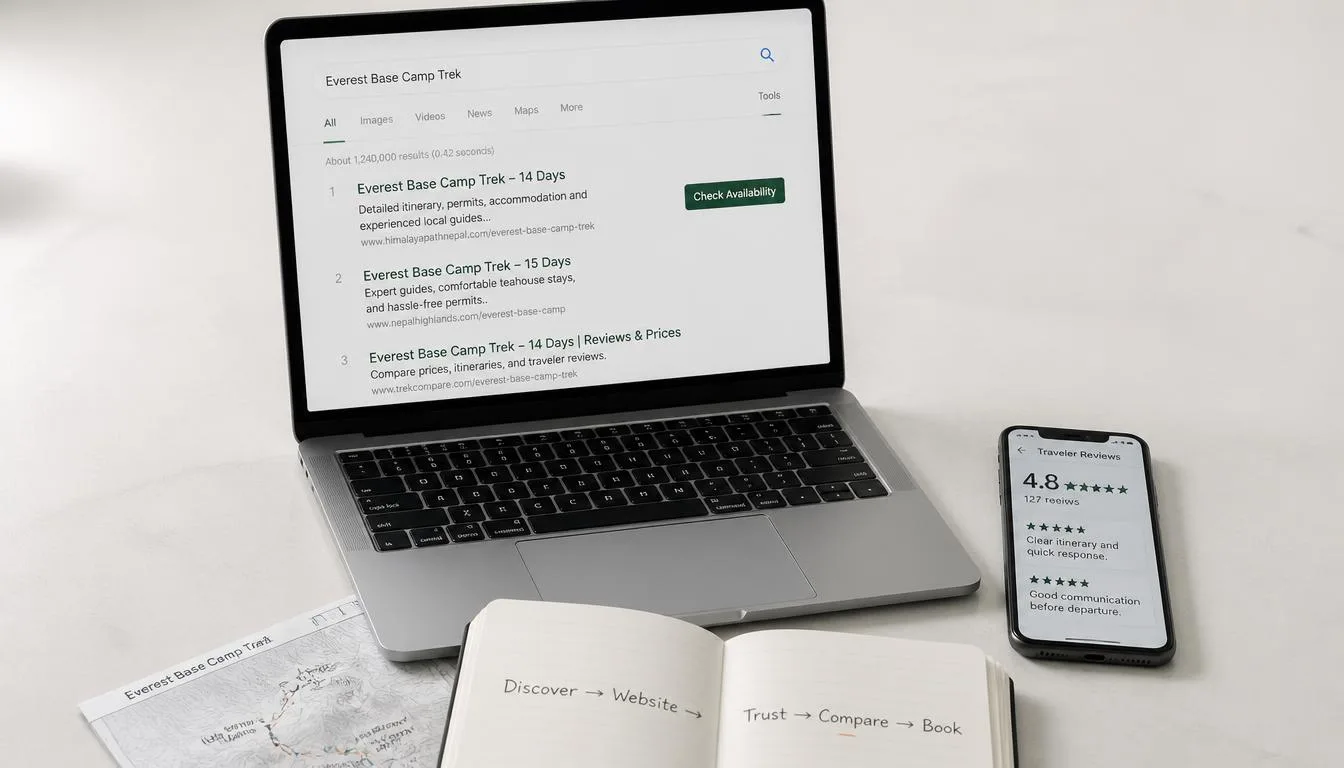
Nepal trekking inquiries often go quiet after first contact because the reply is slow, generic, or leaves key questions unanswered.
Travelers usually compare 2 to 3 agencies at once, so trust, pricing clarity, and booking process decide who gets the reply, not just the itinerary.
You get an inquiry. Everest Base Camp, 14 days, two people, October. You reply with the itinerary and price. Then nothing.
A day later you follow up. Still quiet. A week later you see they booked with someone else, or with an OTA you also compete against.
That quiet is not random. It follows a pattern. This article maps where trekking inquiries go quiet after the first message and what to check before you spend more on getting inquiries.
Key takeaways
- An inquiry signals interest, not commitment. The traveler is usually messaging 2 or 3 agencies at the same time.
- Most leaks happen in the first 48 hours: slow reply, copy paste itinerary, unclear inclusions, or no clear next step.
- Travelers check you while you reply. Team, reviews, payment method, and policy answers influence whether they write back.
- Price rarely kills the booking alone. Unclear value, payment uncertainty, and weak differentiation do.
- Your reply system is part of acquisition. Speed, specificity, and reduction of uncertainty decide who gets the second message.
- The right fix is diagnosis before more traffic. Find where momentum breaks, then fix that stage.
The Quiet After Hello
A trekking inquiry feels like progress. Someone found you, liked the trek, and took time to write. It is progress, but it is also a test.
From your side the journey looks simple: Inquiry → Reply → Booking. From the traveler side it is longer: Discovery on Google → Website scan → Message 2 or 3 agencies → Wait for replies → Compare replies → Check trust → Decide who feels safest to pay.
If your reply does not move them from comparison to confidence, the conversation goes quiet. Not because they lost interest in the trek, but because another reply made the decision easier.
An Inquiry Is Not a Commitment
Treat an inquiry as permission to continue the conversation, not as intent to book with you. The traveler is still deciding between agencies, OTAs, referrals, and waiting.
| Stage | What the traveler is asking | What you need to prove |
|---|---|---|
| Google discovery | Who does this trek well? | Relevance |
| Website visit | Does this company look credible? | Clarity and trust |
| Inquiry sent | Who replies best? | Speed and specificity |
| Reply comparison | Who do I trust to pay? | Evidence and transparency |
| Decision | Where do I book? | Low uncertainty |
| Booking | Am I safe to commit? | Process and assurance |
Many agencies measure inquiries. Fewer measure how many inquiries become qualified conversations, and how many of those become bookings. That gap is where quiet happens.
Getting traffic and inquiries but not bookings? The problem often sits between visibility and trust. See my approach to SEO for travel and trekking businesses where inquiry quality and conversion are part of the system, not afterthoughts.
What Travelers Do After They Message You
After hitting send, the traveler does not wait quietly for your reply. They keep researching.
In parallel they search your company name, check reviews on Google and TripAdvisor, look at your About and team pages, compare your itinerary with two other replies, and ask in a Facebook group if anyone has heard of you. They also recheck cancellation, payment method, and what happens if altitude or weather changes the plan.
Your website and your reply need to answer that parallel research without the traveler having to ask each time.
| Traveler check | What they look for | Typical signal |
|---|---|---|
| Company identity | Real company, real office, real contacts | About, contact, registration clarity |
| Operational proof | Who actually guides the trek | Team and guide information |
| Review proof | Consistent genuine reviews | Third party reviews, not just site quotes |
| Offer clarity | Itinerary, inclusions, exclusions | Detailed page, not a PDF alone |
| Booking confidence | Payment, deposit, policy | Transparent terms, no surprises |
If any of these checks create doubt while they wait for you, they do not tell you. They just stop replying.
Where Inquiries Actually Go Quiet
Use this as a diagnostic. None of these show up as a ranking problem. Your Search Console can look healthy while inquiries go quiet.
| Leak point | What traveler experiences | Why they go quiet |
|---|---|---|
| Slow first reply | Waited 12 to 36 hours | Another agency replied first and helped them decide |
| Generic reply | Same itinerary, no answer to their question | Feels like copy paste, not expertise |
| Unclear inclusions | Still not sure what price covers | Fear of hidden costs, keeps comparing |
| Price without context | Price given, value not explained | Cheaper option feels safer |
| Weak proof | Cannot find team or real reviews | Trust gap, perceived risk rises |
| Payment uncertainty | How do I pay, what if I cancel | Delay, then books on OTA with familiar checkout |
| No clear next step | What do I do now | Friction, conversation stalls |
| Follow up without value | Just checking in messages | No new reason to re-engage |
Your First Reply Is Your Real Homepage
For many travelers the first reply is the first time they can judge how you operate. Your website created the interest, but the reply creates the confidence.
A strong first reply does four things in one message: acknowledges their specific ask, answers what they actually asked, reduces the next uncertainty before they ask, and gives a clear next step. A weak reply sends a brochure and waits.
- Acknowledge specifics: Dates, group size, fitness level, arrival concerns. Show you read the message.
- Answer directly: Itinerary adjustments, difficulty, inclusions, exclusions, logistics, permits.
- Reduce risk early: Deposit, payment method, cancellation, guide, safety, communication before and during trek.
- Make next step obvious: Check availability, customize, call option, or short call link, without pushing for payment.
Speed matters because comparison does not wait. Specificity matters because travelers can feel a template reply in one paragraph.
Price Is Rarely the First Reason
Most operators assume quiet means price was too high. Sometimes it is. More often the traveler did not understand what the price includes, why it differs from another quote, or what risk the price protects them from.
Two quotes for 14 day Everest Base Camp can differ by hundreds of dollars and still both be reasonable, depending on guide ratio, accommodation, transport, permits, contingency, and support. If you give a number without that context, the lower number wins by default because the traveler has nothing else to decide on.
Helpful pattern:
- The trek page answers: What will this trip be like day by day?
- The inclusions answer: What am I paying for, and what is extra?
- The proof answers: Why should I trust this company with this price?
- The process answers: What happens after I say yes?
When those answers live in your reply and your website together, price becomes a value decision instead of a guess.
Trust Checks Happen While You Wait to Reply
Even with a fast reply, travelers verify you in parallel. They search your brand, read reviews, and compare your team page with another agency that shows guides by name.
| Trust question | What reduces doubt |
|---|---|
| Is this company real? | Clear About, contact, address, consistent business presence |
| Who will guide me? | Guide experience, team, language, safety focus |
| Are reviews real? | Third party reviews, recent dates, consistent names and trips |
| What if I need to change? | Written cancellation and change terms before payment |
| How do I pay safely? | Payment method, deposit amount, receipt, invoice |
| How will you communicate? | Response time promise, WhatsApp or call option, pre-trek briefing |
You do not need to claim you are the best. You need to make trust verifiable in two minutes. That is the difference between a reply that gets a second message and one that goes quiet.
What a Strong Inquiry to Booking System Looks Like
Think of post-inquiry as a system with six stages, each with one clear outcome.
- Reply fast with context. Within hours, not days. Use their name, trip, dates, and question. Confirm availability or next check.
- Prove you operate this trek. Mention relevant guide experience, recent departures for the same route, and operational detail that only an operator would know.
- Clarify commercial detail. Inclusions, exclusions, transport, permits, accommodation standard, and what affects price. Link to the page that shows it in full so they can verify without asking again.
- Reduce risk before asking for money. Payment method, deposit, cancellation, altitude and weather contingency, communication during trek.
- Differentiate on fit. Why this itinerary fits their fitness, dates, and expectations, not generic claims about service.
- Make reply easy. One question to answer, one link to confirm, one easy way to talk. No long form to fill after they already wrote to you.
Reply checklist before you hit send
Does my reply answer their exact question in the first three lines, and does it give them a single next step?
- Used their dates, group size, and request verbatim
- Answered inclusions, exclusions, and logistics without a second email needed
- Linked to the trek page and review profile for verification
- Stated deposit, payment method, and change policy plainly
- Ended with one clear action: confirm, customize, or talk
Content That Keeps Momentum After Contact
The most useful content after inquiry is not a new blog post. It is the pages and messages that prevent a second round of comparison.
Decision-stage content that keeps momentum:
- Everest Base Camp Trek Cost: explains the value behind the number
- What Is Included and Excluded: removes hidden cost fear
- Everest Base Camp Trek Difficulty: helps them self select and trust your assessment
- Who Guides the Trek and Safety Process: reduces risk perception
- How Booking and Payment Works: makes the final step feel normal
Link that content inside your reply. Do not make the traveler search your site to find it. You can see how inquiry quality connects to content and conversion in the trekking SEO case study where search visibility was tied to leads, not just traffic.
The Metrics That Actually Matter
| Vanity metric | Better business question |
|---|---|
| Inquiry count | How many inquiries are qualified for this trek and season? |
| Reply count | How many got a specific reply within hours? |
| Open rate | How many replied back after the first answer? |
| Traffic | Are the right travelers arriving from high intent searches? |
| Leads | How many inquiries became sales conversations? |
| Bookings | Which inquiry sources actually produce bookings? |
| Revenue | What does each channel contribute after commission? |
The shift to track is from We got 42 inquiries to 18 were qualified for EBC in October, 12 re-engaged after the first reply, and 5 booked direct.
Already ranking but inquiries go quiet? Compare this framework with your own journey in Why Nepal Trekking Agencies Lose Direct Bookings, the pre-inquiry version of the same leak, from click to inquiry.
What I Would Diagnose First
Before chasing more inquiries, examine five things in order:
- First reply time and specificity. Check the last 20 inquiries. How fast did the first helpful reply go out, and did it answer their exact question or send a generic itinerary?
- Inquiry to second message rate. How many inquiries reply after your first message? If it is low, the leak is in that message, not in traffic.
- Commercial clarity. Can a stranger understand inclusions, exclusions, and payment terms from your trek page alone without asking you?
- Trust verifiability. Can someone who never heard of you verify team, reviews, and operation in two minutes?
- Channel comparison. How does direct inquiry close rate compare with OTA or referral close rate for the same trek?
The answers show whether the opportunity sits in response process, website proof, offer clarity, or channel strategy. Fix the leak before adding more water.
From Quiet Inquiries to Owned Demand
Travelers will keep messaging multiple agencies. They will keep checking OTAs and review sites. Your job is not to stop comparison. It is to win it by reducing uncertainty faster than the next reply.
Relevant inquiry → Fast specific reply → Proof they can verify → Clear offer and inclusions → Transparent payment and policy → Easy next step → Qualified conversation → Direct booking and ownership
When that system works, quiet becomes rare. Not because you persuade harder, but because you make the decision easier.
Trekking agencies can get inquiries from Google, referrals, and social and still watch most go quiet. Often search and marketing did their job. The leak happened after contact, when the reply was slow, generic, left pricing unexplained, or forced the traveler to verify trust on their own.
The journey is discovery → website evaluation → inquiry → reply comparison → trust check → payment decision. Your job is to find where it breaks and fix the part costing you bookings. That is also how I approach travel SEO: not as rankings alone, but as connecting relevant demand to a site and a follow up system capable of turning it into business. You can see how that system thinking translated into measurable growth in the case studies.
Want to know where your trekking inquiries go quiet? I diagnose where inquiries lose momentum between search, website trust, and your reply process, so you know what to fix before buying more traffic.