Usually, no. Trekking agencies should not leave GetYourGuide or Viator simply to avoid commissions. OTAs can provide valuable discovery and booking volume, especially when an agency has limited direct demand.
The stronger strategy is to use selected OTAs as an acquisition channel while building direct demand through search visibility, brand awareness, reviews, repeat bookings and a low friction website. The goal is not zero OTA bookings. It is reducing dependence on OTA bookings while increasing profitable direct bookings.
A trekking agency lists a 14 day Everest Base Camp trek on GetYourGuide, wins bookings from travelers it would never reach alone, then watches a large share of the revenue leave before it touches the business. Next season the same thing happens, because the same travelers book through the same platform again.
This is a narrower post than my broader breakdown of why Nepal trekking agencies lose direct bookings even when travelers find them on Google. That piece maps the full leak from click to booking. This one answers one commercial question: OTAs give you bookings, but you are giving away margin and becoming dependent on somebody else's marketplace, so what should you actually do.
Key takeaways
- OTA commission reduces the revenue a trekking agency keeps from each booking.
- OTA dependency is different from using OTAs. OTAs can be valuable for discovery without becoming the foundation of the business.
- Viator and GetYourGuide do not publish one universal commission rate for every supplier.
- Direct bookings can improve margin and customer relationship control, but direct acquisition is not free.
- The strongest strategy is usually hybrid: selected OTA distribution plus growing direct demand.
- Measure contribution margin and repeat demand by channel, not just booking volume.
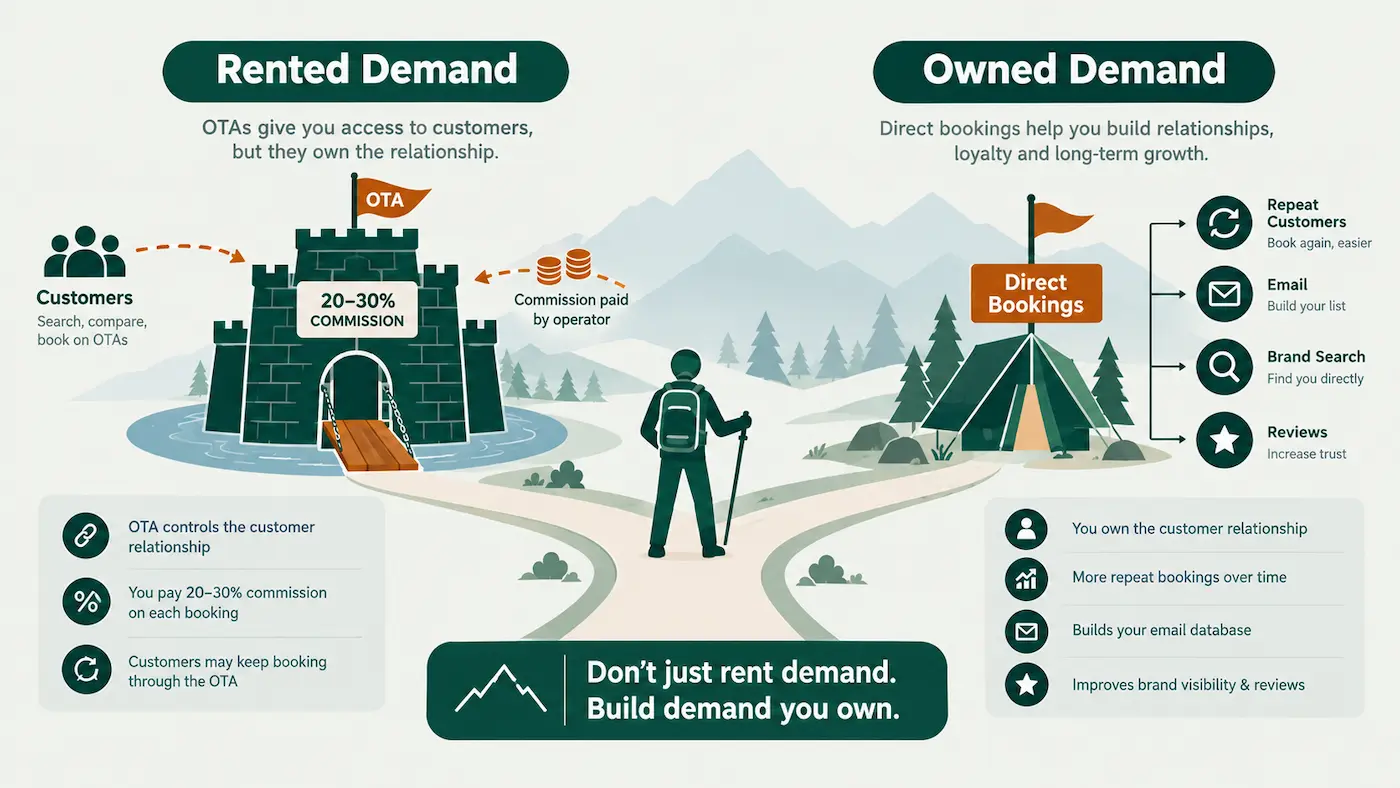
Rented Demand Fills Trips. Owned Demand Builds the Business.
Rented demand is demand that lives inside somebody else's marketplace: OTA traffic, marketplace visibility, marketplace reviews and marketplace generated bookings. It carries commission, limited customer relationship control and dependence on platform rules. Owned demand is demand your business controls: organic search, brand searches, direct website traffic, direct inquiries, permission based customer records, repeat bookings, referrals and brand reputation.
The problem is not rented demand. The problem is allowing rented demand to become the foundation of the business. A trekking agency that fills every departure through marketplaces grows bookings while its margin, customer data and repeat demand compound inside somebody else's system.
Viator and GetYourGuide Commission Rates: What Operators Actually Pay in 2026
Neither platform publishes one simple universal supplier rate that applies to every operator, so treat any single number as a reported range, not an official price list. Industry sources commonly report Viator supplier commission around 20 to 30 percent, with higher effective rates possible through Accelerate. GetYourGuide commission varies by supplier and market, with industry sources commonly reporting rates in the 25 to 30 percent range and the exact rate depending on the supplier agreement and applicable pricing and payment configuration.
| Platform | What is documented or reported | What pushes the effective rate higher |
|---|---|---|
| Viator | Industry sources commonly report roughly 20 to 30%; Viator does not publish a universal supplier table | Accelerate placement, where suppliers offer higher commission for increased ad exposure, plus 29 dollars per new product submission since August 2025 |
| GetYourGuide | Varies by supplier and market; industry sources commonly report 25 to 30% | Program and payment configuration, including a payment modifier for twice monthly payouts that industry sources report at about 2 points |
| Booking.com attractions | Industry sources commonly report 20 to 25% | Visibility boosters and operator funded discount programs |
Three distinctions keep this honest. First, base supplier commission is not the same as Accelerate commission. Viator officially documents Accelerate as a program where suppliers raise commission above the minimum rate in exchange for more ad exposure (supplier.viator.com/accelerate), which means commission can be part of the visibility equation on Viator without proving that paying more ranks a product higher everywhere.
Second, supplier commission is not affiliate economics. Viator's widely quoted 8 percent figure is the affiliate referral rate for partners who send traffic, not the operator rate (SambaHQ OTA commission guide).
Third, GetYourGuide officially documents a configurable commission breakdown system with pricing category rates and payment modifiers rather than a single universal percentage (GetYourGuide Supply Partner Help Center). Reported ranges come from industry sources such as OTA Playbook and Automate.travel. Verify your own contract before modeling, because the effective rate moves with program and payment choices.
Paying OTA commission on every departure? The fix is rarely delisting. It is a channel mix with owned conversion. See my approach to SEO for travel and trekking businesses where direct demand is part of the system, not an afterthought.
What Does OTA Dependency Actually Cost a Trekking Agency?
Think in three layers. Layer one is immediate economics. On a 1,400 dollar trek at 25 percent commission, the commission is 350 dollars and the agency retains 1,050 dollars before guides, permits, flights and all other costs.
That subtraction is valid and worth modeling. What it is not is the full cost comparison, because direct bookings carry their own acquisition costs.
Layer two is scale economics. Eight travelers at 1,400 dollars each is 11,200 dollars of gross revenue. At 25 percent, the commission is 2,800 dollars and the agency retains 8,400 dollars before other costs.
Ten such groups in a season is 28,000 dollars in commission. When guide wages and ad costs rise at the same time, that gap decides whether a full season was profitable or merely busy.
Layer three is strategic cost, and it has no single dollar figure. Marketplace dependence means less direct customer relationship, dependence on marketplace specific reviews, customer acquisition dependence, vulnerability to commission and ranking changes, repeat demand leakage and reduced flexibility. Do not assign fake dollar values to these. Name them, weigh them and price the risk into distribution decisions instead.
| Channel | Main cost |
|---|---|
| OTA bookings | Marketplace commission plus applicable program and payment costs |
| Direct bookings | Payment plus booking technology plus customer acquisition costs such as SEO, content, paid search, social, sales, email, website, staff and brand building |
This is the apples to apples correction. Comparing a 25 percent OTA commission against 2 to 3.5 percent payment and technology cost is economically misleading, because it treats direct acquisition as free. Direct can still win on margin and control, but only when the full acquisition cost is measured per channel.
What Does the OTA Control Besides the Commission?
Four items, each defined narrowly so the claim stays defensible:
| Item | What the platform controls | What it means for you |
|---|---|---|
| Marketplace visibility | Its own merchandising, ranking and promotional environment | Placement can shift with rules and programs; on Viator, Accelerate explicitly links higher commission to increased ad exposure |
| Marketplace reviews | The review ecosystem attached to your listing | The platform hosts that listing specific social proof; your wider reputation still lives across Google, TripAdvisor and referrals |
| Booking environment | The checkout the customer transacts through | Terms, messaging and post booking communication follow marketplace systems and restrictions |
| Customer relationship | The communication environment around the booking | You do not have the same unrestricted relationship you would have with a direct booking; supplier access to customer information follows platform rules |
OTA Bookings Are Rising While Direct Website Bookings Are Falling
Arival Global Operator Landscape 4th Edition, published January 2026 from 5,664 qualified operator responses, reports OTAs at 37 percent of tour and activity bookings in 2025, up from 33 percent in 2024 and 28 percent in 2023, while operator website bookings fell from 29 percent to 25 percent over the same year. Total online stayed near 60 percent, so the story is not more online booking. It is more platform booking inside the same online total (Arival, PhocusWire).
Read this carefully. The data covers the broader experiences market, not specifically Nepal trekking agencies, so it does not prove trekking agencies are becoming dependent on OTAs. What it does show is that the broader market is moving toward greater OTA share, which makes distribution strategy increasingly important for trekking operators.
Arival also points to rising digital marketing costs and AI driven changes in search that make direct acquisition harder and less predictable.
How Hotels Reduced OTA Dependency and What Trekking Can Borrow
Use hotels as a distribution analogy, not as proof that trekking behaves identically. Independent hotels have lived the same marketplace mechanics with Booking.com for years: a platform owns discovery, charges commission in the mid teens to mid twenties once programs stack, mediates the guest and rewards visibility spend. Their toolkit translates because the mechanics match, even though the products differ.
Three patterns are worth borrowing. First, the sentiment pattern: hosts describe years on Booking.com as feeding the machine, meaning each booking funds the platform that then sells the same guest to a competitor. Second, the recovery pattern: operators who added simple direct infrastructure report growing direct share with better margin, through QR cards at checkout, a small brand search budget and a direct booking page worth trusting.
Third, the friction pattern: slow, dated, mobile weak booking engines push travelers back to OTAs. None of this claims hotels universally solved OTA dependency. They did not.
It shows which direct investments tend to move the mix.
The hotel toolkit that travels well is unglamorous: in room QR codes to a direct page, a checkout card with a returning guest reason, a post stay email with a direct link, a claimed Google Business Profile with the direct URL, free booking links where available, and direct perks that do not break parity, such as flexible terms or a room level benefit. The trekking version of each item appears in the next section.
How to Reduce OTA Dependency Without Losing Booking Volume
To reduce OTA dependency without losing volume, run both channels with different jobs. The OTA discovers strangers. Your site converts them into direct relationships. Five steps make that real.
1. List selectively, not everywhere. Decide which OTAs produce incremental customers, profitable bookings and useful market reach. Keep one or two listings for discovery on your highest demand trek, usually Everest Base Camp. Do not chase every OTA.
2. Build a compliant path to repeat demand. Build your own customer relationships wherever legally and contractually permitted, and follow the OTA terms plus applicable privacy and marketing rules. Work only with customer information you are permitted to collect and use: post trip experience follow up, permission based email, your own website inquiries, future trip inquiries, referrals, repeat customer programs and brand search. For proof of how search plus trust work once the base is fixed, see the trekking case study where search visibility turned into consistent inquiries.
3. Win the brand search after the trek. Past guests search your agency name plus reviews before recommending you. Build Google Business presence, reviews, branded content, destination content and direct itinerary pages so the next purchase does not have to happen through the same marketplace. My post on the TripAdvisor verification tax covers what that proof needs to contain.
4. Fix direct booking friction. Before buying more traffic, check the direct path end to end: clear itinerary, visible pricing, trust signals, reviews, FAQs, availability, payment, mobile usability and a clear call to action. My work on SEO for travel and trekking businesses treats this as acquisition infrastructure for exactly this reason.
5. Measure profit, not OTA booking volume. Booking counts flatter OTAs. Contribution margin by channel tells the truth, because delivery cost is yours in both cases. The next section gives the framework.
How Should a Trekking Agency Measure OTA Dependency?
Track these by channel, monthly, before changing listings or spending on ads:
| Metric | Why it matters |
|---|---|
| Revenue by channel | Shows where volume actually comes from |
| Contribution margin by channel | Shows what each channel keeps after delivery and acquisition cost |
| Commission and program cost | Captures base rate plus placement, payout and processing uplifts |
| Acquisition cost per booking | Lets direct spend be compared honestly against commission |
| Booking conversion rate | Reveals friction in the direct path versus the marketplace |
| Repeat booking rate | Shows whether customer relationships compound for you or the platform |
| Direct inquiry rate | Early signal that owned demand is growing |
| Brand search demand | Shows whether past guests look for you by name |
| Customer lifetime value | Captures repeats and referrals the first booking creates |
| OTA share of bookings vs OTA share of profit | The decisive split: a channel can drive 40 percent of bookings but only 25 percent of contribution profit |
Run these five checks alongside the framework:
1. Effective commission per channel. Base rate plus placement uplifts, payout surcharges and processing, per platform, per trek.
2. OTA share of revenue versus profit. Bookings flatter OTAs and profit tells the truth.
3. Repeat rate by first channel. Near zero direct repeats means no capture system exists.
4. Brand search capture. Search your agency name plus reviews and your agency name plus book direct to see who owns the top result.
5. Direct checkout friction. Time strangers through your inquiry on mobile, since every extra step is commission you will keep paying.
Use OTAs for Discovery, Keep the Profit Direct
If all demand lives inside marketplaces, you rent growth at whatever rate the platform sets next. If direct demand also grows, platforms become a useful acquisition channel instead of the foundation. That is the hybrid model worth building: listed where strangers compare, chosen where past guests return.
Distribution economics decide who keeps the margin on the same trek. The agency that captures the guest through permitted channels, earns reviews across property it controls and makes the second booking direct keeps compounding. The agency that only fulfills keeps working.
Want to know what your OTA dependence actually costs? I can map your channel mix, effective commission and direct capture gaps before you renegotiate listings or spend more on traffic.
Frequently Asked Questions
Usually, no. Keep one or two OTA listings for discovery where strangers compare, especially while direct demand is limited. Build direct capture around those listings through brand search, reviews and permitted follow up. Exiting removes volume without fixing the reason direct was weak. The goal is reducing dependence while profitable direct bookings grow.
Neither platform publishes one universal supplier rate. Industry sources commonly report Viator around 20 to 30 percent, with higher effective rates through Accelerate placement. GetYourGuide varies by supplier and market, with industry sources commonly reporting 25 to 30 percent and payment configuration affecting the total. Always verify your own contract for the effective rate.
List selectively on the OTAs that bring incremental customers, build a compliant path to repeat demand using only permitted customer information, win brand search after each trek, remove friction from the direct inquiry path and measure contribution profit by channel. Let the OTA share of profit fall while discovery volume stays useful.
Build the direct channel as a system: a fast mobile inquiry path, brand search presence so past guests find you first, Google review depth that makes direct feel safe, and email plus WhatsApp follow up that turns one trek into repeats and referrals. Track direct share of profit monthly to confirm the mix is shifting.
It depends on the traveler. Marketplaces suit first time comparison across many operators with standardized checkout. Booking direct suits repeat travelers, custom itineraries and anyone who values a direct relationship with the team leading the trek. A strong agency makes both paths easy and lets the relationship move direct over time.
Compare contribution margin by channel, not headline rates. Add commission plus program and payment costs on the OTA side, and payment plus technology plus acquisition spend such as SEO, content, ads and staff time on the direct side. A channel can drive 40 percent of bookings but only 25 percent of contribution profit, which tells a different story than volume alone.
Follow up after every trek with photos, a review request and a reason to return, using only contact details you are permitted to use. Add seasonal offers, a repeat customer benefit and a referral path, and keep brand search strong so the next booking starts on your site. Each repeat direct booking is margin the marketplace never touches.
Sources and Methodology
Commission rates can vary by supplier, market, program and payment configuration. Where platforms do not publicly disclose a single universal rate, this article distinguishes official platform documentation from industry reported ranges.
- GetYourGuide commission breakdown system, including pricing category rates and payment modifiers. GetYourGuide Supply Partner Help Center, updated April 2026
- GetYourGuide supplier commission varies by country of operation, confirmed after signup. GetYourGuide supplier pages
- Viator Accelerate: suppliers raise commission above the minimum rate for increased ad exposure, with no upfront costs. Viator supplier site
- Viator Accelerate program background and operator reporting. Viator Operator Resource Center
- OTA commission models and reported ranges for Viator, GetYourGuide, Klook and Booking.com. OTA Playbook, June 2026
- GetYourGuide reported commission ranges. OTA Playbook GetYourGuide guide
- Multi-day operator commission analysis. SambaHQ supplier guide, April 2026
- Viator versus GetYourGuide operator comparison. Automate.travel, May 2026
- Arival Global Operator Landscape 4th Edition: 5,664 operators, OTA share 37 percent in 2025 versus 33 percent in 2024 and 28 percent in 2023, operator websites 29 to 25 percent. Arival, January 2026
- Arival channel shift coverage. PhocusWire, February 2026
- Everest Base Camp standard guided packages 1,400 to 2,200 dollars. Mission Himalaya Treks, June 2026
- Everest Base Camp cost breakdown for guided treks. Buddy the Traveling Monkey, June 2026
- Direct booking infrastructure costs and tactics for tour operators. Basecamp Advertising
- Direct booking commission recovery playbook. Hamza Liaqat, March 2026