
How I Rebuilt Organic Acquisition for a Nepal-Based Trekking Agency
SEO Case Study: 43% More Organic Clicks, 37% More Visibility, 40% More Leads in 5 Months
This was not a visibility problem alone. It was a structure problem.
The client was a Nepal-based trekking agency offering tour packages across multiple regions. They had an existing website, real traffic, and occasional inquiries, but organic search was not working as a consistent acquisition channel
The goal was to fix that by restructuring how a site connects to the people who are actually ready to book. Over five months, the results were measurable across every layer of the funnel.
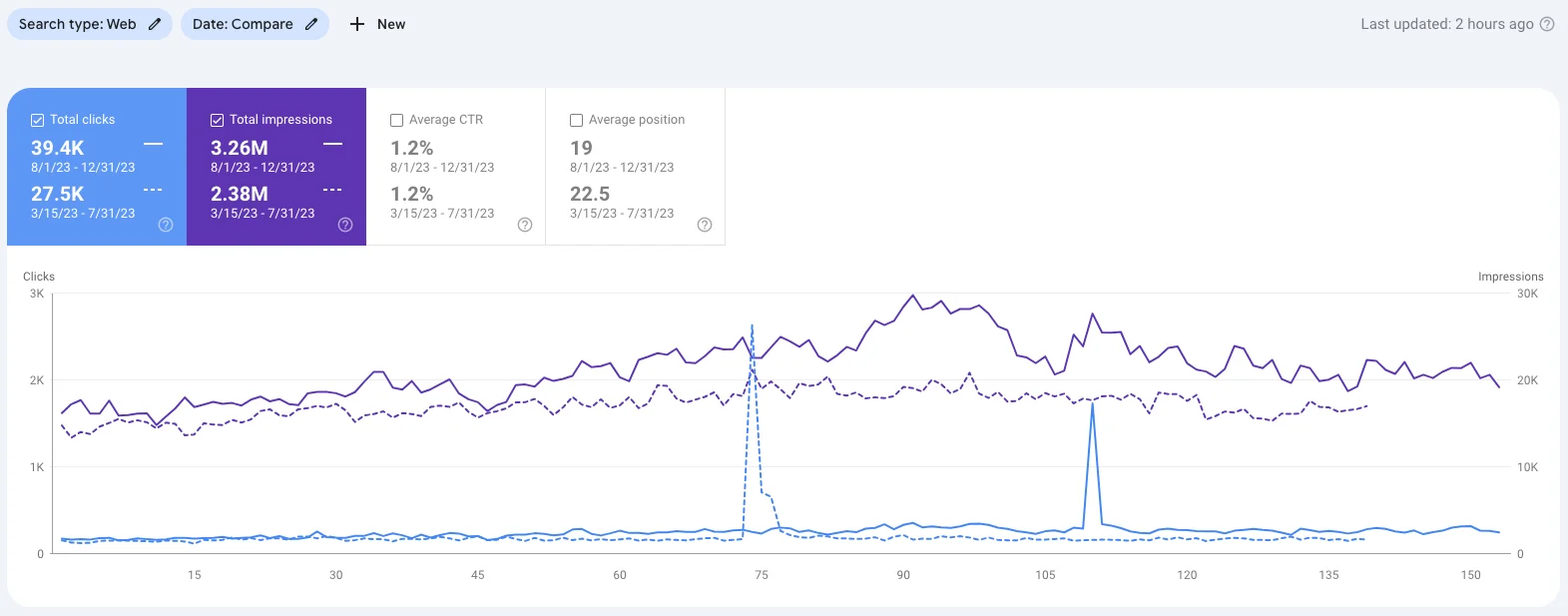
- Organic clicks grew from 27,500 to 39,400, a 43% increase
- Lead inquiries increased by over 40%. The agency moved from irregular organic inquiries to a consistent weekly pipeline of booking requests.
- Organic visibility grew from 2.38 million to 3.26 million, a 37% increase
- Average position improved from 22.5 to 19 across the entire site
- CTR held at 1.2% across both periods, meaning the new content was attracting the right searches, not just more searches. Growing visibility by 37% while keeping click rate flat is intent alignment working, not volume publishing.
Where the Site Stood Before I Started
When I took over in August 2023, the site had generated 27,500 organic clicks and 2.38 million organic visibility in the preceding five months. Average position across the site sat at 22.5.
The numbers were not zero. The problem was that the traffic was not translating into consistent inquiries. Important commercial pages were not ranking at decision-stage positions. Most content was not aligned with how travelers actually search for trekking packages. The site was also built on a custom Laravel framework, which made implementation slower and required every change to be prioritized carefully.
This was not a content volume problem. The foundation itself needed to be realigned around how buyers actually search and decide.
That project is a good example of what travel SEO looks like as an ongoing service, beyond the initial audit and fixes.
If you’re running a travel business and want to understand what’s realistic for your site, talk to an SEO expert in Nepal who has done this before.
What the Diagnosis Revealed
Before touching anything, I focused on three questions:
- How do travelers actually search for trekking in Nepal? Most queries were not generic. They were specific to routes, difficulty levels, duration, and season. Searches like "Annapurna Circuit 10 days" or "Everest Base Camp difficulty level" represent a traveler who has already decided they want to trek and is now evaluating options. The existing site was not aligned with that level of intent.
- Where was value being lost? Some pages had traffic but were not converting. Others had clear commercial potential but were not discoverable because of weak internal linking and poor page structure. The gap between visibility and clicks, and between clicks and inquiries, pointed directly to a structure problem.
- What would realistically move the needle given the constraints? The Laravel framework meant every implementation decision had to be deliberate. Each change needed to earn its place based on expected impact, not just because it was technically correct.
The Strategy: Sequence Over Volume
Rather than running every optimization in parallel, the work was sequenced by impact. Here is what that looked like in practice.
- Prioritising commercial pages first. Core trekking pages tied to route-specific and duration-specific queries were restructured before any content expansion began. These pages had the highest probability of driving inquiries and needed to be the foundation everything else was built on.
- Fixing the technical foundation early. Page speed issues, URL inconsistencies, and crawl inefficiencies were resolved in the first phase. A site that cannot be properly crawled and indexed will not rank regardless of how strong the content is. This had to come before anything else.
- Rebuilding internal linking around priority pages. Link equity was flowing to the wrong pages. The internal linking architecture was rebuilt so authority flowed toward commercial pages rather than being distributed randomly across the site.
- Expanding content with intent, not volume. Once the foundation was stable, content was expanded specifically targeting route-based and decision-stage queries. Every new piece was mapped to a specific search behavior, not published to fill a content calendar.
What I Took Away From This Project
- Not all traffic is valuable. Growing visibility without improving intent alignment produces visibility, not business results. The CTR staying flat while visibility improvement confirmed the right queries were being captured.
- Trekking search behavior is highly specific. Travelers searching for trekking in Nepal are not using broad terms. They are searching by route, duration, season, and difficulty. Generic content consistently underperforms against pages that match those real decision-stage queries
- Constraints force better decisions. The Laravel framework limitation meant every change had to be deliberate. That constraint produced a cleaner, more prioritized result than an unconstrained project often does.
- Earlier content expansion would have compounded faster. Structured content targeting high-intent route and duration queries could have been introduced from Month 2 rather than Month 3. That is what I would do differently.
Address
- Kathmandu, Nepal
- info@aruntamang.com.np